
The Knowledge Work Plugins Project, Small Language Models - New Book| Issue 89
A weekly curated update on data science and engineering topics and resources.

This week's agenda:
Open Source of the Week - The Knowledge Work Plugins project
New learning resources - MIT Game Theory course, text classifier course, n8n course, open weighted comparison
Book of the week - Small Language Models: Efficient AI for Local Deployment by Guglielmo Iozzia
The newsletter is also available on LinkedIn and Medium.

I opened my LinkedIn Learning courses for a limited time via the links below:
Open Source of the Week
Knowledge Work Plugins is an open source project from Anthropic that provides a collection of customizable plugins for AI-powered workplace workflows. Rather than relying on generic AI assistants, the project packages domain expertise, workflows, commands, and external tool integrations into reusable role-specific plugins. These plugins can turn an AI assistant into a specialized collaborator for areas such as sales, product management, customer support, finance, or data analysis. The goal is to help organizations create AI systems that better reflect their own processes, terminology, and tooling rather than repeatedly recreating context through prompts.
Project repo: https://github.com/anthropics/knowledge-work-plugins
Key Features
Provides role-specific plugins for domains such as productivity, sales, customer support, product management, finance, legal, and data analysis.
Bundles skills, commands, and tool connectors into reusable packages that extend AI capabilities.
Supports integrations with external systems, including Slack, Notion, Jira, HubSpot, Snowflake, BigQuery, Databricks, and Microsoft 365.
Uses MCP (Model Context Protocol) connections to securely connect AI assistants to enterprise tools and data sources.
Built with a file-based architecture using Markdown and JSON, avoiding complex infrastructure or custom code.
Designed to be fully customizable, allowing organizations to adapt workflows, terminology, and business processes.
Includes tooling for creating and managing new custom plugins, making it easier to extend AI workflows across teams.
License: Apache 2.0
New Learning Resources
Here are some new learning resources that I came across this week.
MIT Game Theory Course
This MIT full-semester course provides an introduction to the economic applications of game theory. It covers core game theory topics such as Nash equilibrium, backward induction, folk theorem, Bayesian games, as well as practical applications such as Ad auctions, bargaining, and signaling.
Build a Text Classification Model
This in-depth tutorial focuses on building a text classification model from scratch using Hugging Face Transformers. This includes the prep steps (data, partitions, etc.) through training, tuning, and evaluating the model, and inference.
n8n Crash Course
The following tutorial from Alejandro AO provides a hands-on introduction to n8n by building an agentic RAG with open LLMS.
Hermes Agent Tutorial
This short tutorial provides a step-by-step guide for setting up a Hermes agent. This includes agent installation, Telegram setup, adding skills, web scraping, MCP tools, etc.
Claude Code vs. Codex vs. OpenCode
This video by NeuralNine compares core code-generation tools: Claude Code, Codex, and OpenCode.
Open LLMs Comparison vs. Claude
This video by xCreate compares various open-weighted LLMs (Mistral Medium 3.5, Kimi K2.6, Qwen, etc.) with Claude.
Book of the Week
This week’s focus is on a new book — Small Language Models: Efficient AI for Local Deployment by Guglielmo Iozzia. This book explores an increasingly important shift in AI: moving from large, general-purpose models toward smaller, specialized language models (SLMs) optimized for specific domains and tasks. Instead of assuming bigger models are always better, it demonstrates how domain-focused models can deliver faster inference, lower costs, better privacy, and efficient local deployment. The book combines theory and practical implementation to show how to build, fine-tune, optimize, and deploy compact AI systems that can run on commodity hardware.
Topics Covered
Small language model foundations — understanding SLMs, transformer architectures, and how they differ from general-purpose LLMs
SLMs vs. LLMs — evaluating tradeoffs between model size, cost, latency, specialization, and business value
Domain adaptation strategies — building models tailored to specific use cases and datasets rather than broad knowledge domains
Fine-tuning techniques — adapting pretrained models with custom datasets and specialized tasks
Open-source tooling and ecosystems — using libraries, frameworks, runtimes, and Hugging Face tooling for SLM development
Optimization and quantization — reducing model size and computational requirements while maintaining performance
Local deployment — running language models on commodity hardware and resource-constrained environments
RAG and AI agents with SLMs — creating retrieval systems and agent workflows without relying exclusively on large foundation models
Domain use cases — applying SLMs to specialized tasks such as code generation, scientific applications, and structured enterprise workflows
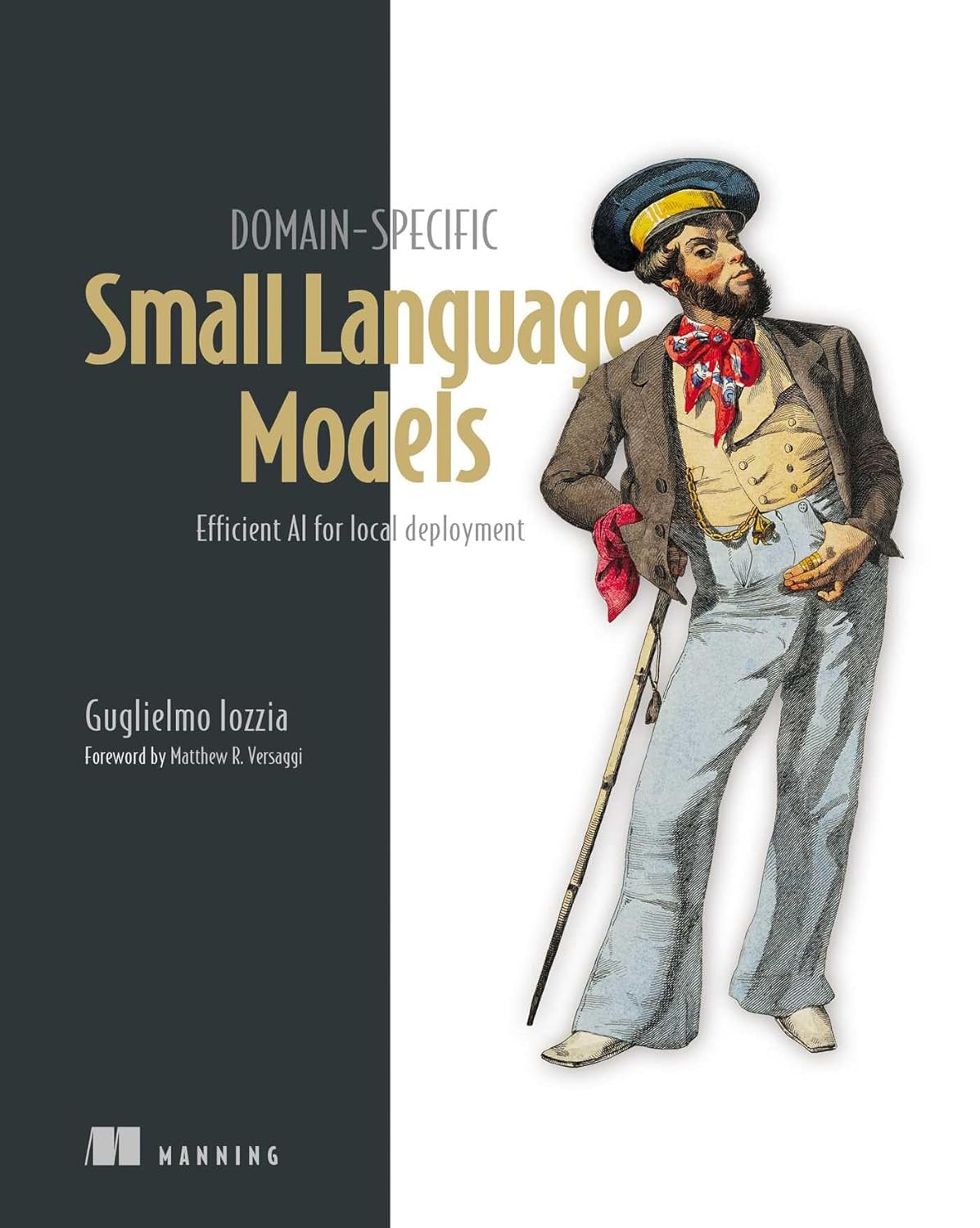
This book is ideal for machine learning engineers, AI practitioners, and Python-experienced developers who want to build efficient, specialized AI systems that run locally and avoid the costs and infrastructure demands of large-scale foundation models.
The book is available for purchase on the publisher’s website and on Amazon.
Have any questions? Please comment below!
See you next Saturday!
Thanks,
Rami