
The Juvio Project, Azure OpenAI Service for Cloud Native Applications, New Learning Resources

This week's agenda:
Open Source of the Week - The Juvio project
New learning resources - Python tutorials for beginners, fine-tune LLM with LoRA tutorial, Langchin agents courses, CrewAI course
Book of the week - Azure OpenAI Service for Cloud Native Applications by Adrián González Sánchez
I share daily updates on Substack, Facebook, Telegram, WhatsApp, and Viber.

Are you interested in learning how to set up automation using GitHub Actions? If so, please check out my course on LinkedIn Learning:
Open Source of the Week
Are you using Jupyter notebooks? Then you should check the Juvio project by Oleh Kostromin. This Juvio project enables you to install Python libraries on Jupyter notebooks using UV as the package manager.
Repository: https://github.com/OKUA1/juvio
The UV package manager is a high-performance package manager for Python written in Rust. It is between 10 and 100 times faster than pip. In addition, it has better dependency management with respect to pip. Therefore, if you are using Juvio, you can enjoy the advantages of UV in Jupyter.
The installation of libraries is straightforward, and it follows the pip format:
%juvio install numpy pandasOnce you install libraries, it creates in the notebook the metadata:
# /// script
# requires-python = "==3.10.17"
# dependencies = [
# "numpy==2.2.5",
# "pandas==2.2.3"
# ]
# ///
This enables other users to reproduce the same environment when launching the notebook.
License: MIT
New Learning Resources
Here are some new learning resources that I came across this week.
Python Tutorials for Non-Programmers
The Python playlist by Prof. Patrick Georges from the University of Ottawa provides a set of tutorials that provide a great intro to Python. This includes topics such as data visualization with Matplotlib and working with images.
Fine-Tuning Local Models with LoRA in Python
LoRA (Low-Rank Adaptation) is a technique for fine-tuning large language models by injecting trainable low-rank matrices into each model layer, allowing adaptation with significantly fewer parameters. This makes training more efficient, memory-friendly (and mainly cheaper) while preserving the original model weights. This one-hour tutorial by NeuralNine, focuses on the theoretical and practical approach for fine-tuning LLMs with LoRA using Python, and it covers:
Theory & Mathematics
Fine-Tuning on Math Problems
Evaluation of Math Problems
Fine-Tuning on Custom Data
Evaluation of Custom Data
Langchain Agents
The following playlist by the AILearner provides an introduction to different use cases on AI agents using the Langchain framework. This includes using Langchain to build:
SQL agent
Custom agent
Custom agent with memory
Dynamic few-shot prompting
CrewAI Course for Beginners
This looks like a great resource for getting started with CrewAI. This course, by Tyler Reed, focuses on developing AI Agents using the CrewAI framework. CrewAI is a lean, lightning-fast Python framework built entirely from scratch.
LangGraph Complete Course for Beginners
A new LangGraph course by Vaibhav Mehra and freeCodeCamp. This three-hour course covers the foundation of LangGraph, and it focuses on designing, implementing, and managing complex dialogue systems using a graph-based approach.
Book of the Week
I had the pleasure of meeting Adrián González Sánchez about a year ago while we both recorded a course for LinkedIn Learning, and since then, I have been impressed by the content he created - books, courses in the domain of Cloud Native and AI. This week's focus is on Adrián's book - Azure OpenAI Service for Cloud Native Applications.
This comprehensive guide demystifies the integration of cutting-edge generative AI models, such as GPT-4 and GPT-4o, within the Microsoft Azure ecosystem and provides practical insights into building scalable, secure, and cost-effective AI solutions. The book covers the following topics:
Implementing cloud-native applications using Azure OpenAI Service
Deploying, customizing, and integrating Azure OpenAI Service with your applications
Customizing large language models and orchestrating knowledge with company-owned data
Utilizing advanced roadmaps to plan your generative AI projects
Estimating costs and planning generative AI implementations for adopter companies
Managing data privacy, security, and performance optimization
Exploring real-world use cases and expert insights
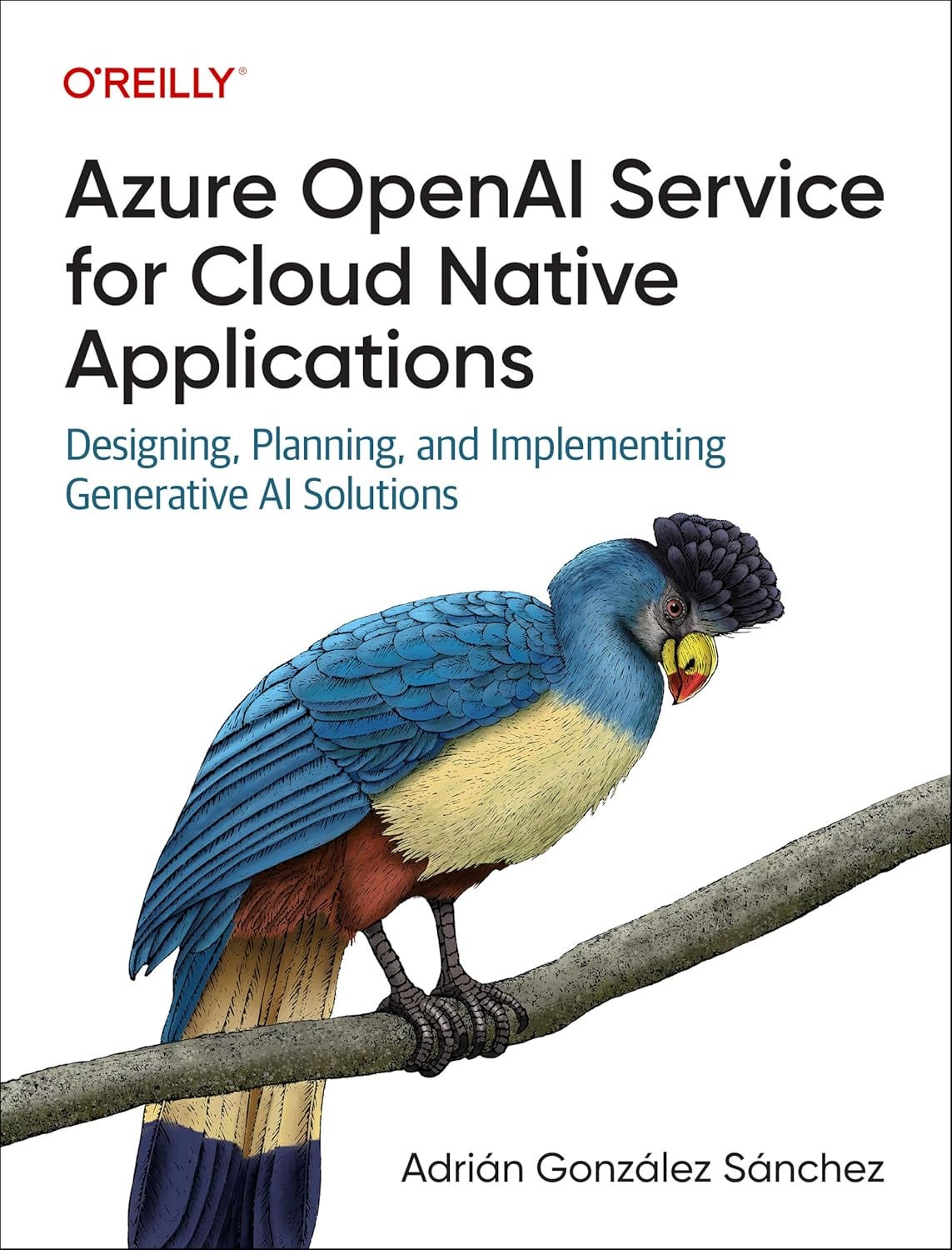
This book is ideal for software and cloud developers, product managers, architects, engineers, and cloud-enabled data scientists aiming to harness Azure's AI capabilities for innovative solutions.
The book is available online for reading on the O'Reilly platform (for subscribers), and a printed version is available for purchase on Amazon.
Have any questions? Please comment below!
See you next Saturday!
Thanks,
Rami