
The Forge3D Project, Transformers Beyond NLP | Issue 99
A weekly curated update on data science and engineering topics and resources.

This week’s agenda:
Open Source of the Week - Forge3D by Milos Popovic
New learning resources - Codex workflows, local model fine-tuning, context layers for AI agents, and Terraform by Nicole Koenigstein
Book of the week - Transformers: The Definitive Guide
The newsletter is also available on LinkedIn, Substack, and Medium.

Do you want to learn how to containerize your AI and machine learning applications with Docker? Check out my new LinkedIn Learning course:
New Course: Docker for Local AI App Development—from Prototype to Production

I am super excited about the release of my new course with LinkedIn Learning—Docker 🐳 for Local AI App Development: Build Lightweight, Containerized AI Applications! 🚀
Open Source of the Week
This week’s focus is on the Forge3D project. Forge3D is an open-source, Python-first terrain and scene renderer built on Rust and WebGPU. It combines interactive viewing with native and off-screen rendering, giving GIS and Python users one workflow for exploring terrain and generating output images. Rather than building a separate rendering stack around geographic data, users can load GeoTIFF files or NumPy digital elevation models, add overlays, labels, and point clouds, and control the camera and lighting from Python. The project is distributed as Python wheels and includes optional extras for Jupyter widgets and sample datasets. Its repository also documents a separate Pro workflow for cartographic composition, vector export, building imports, and scene bundles.
Project repo: https://github.com/milos-agathon/forge3d
Key Features
Interactive terrain viewing — opens terrain scenes through an asynchronous viewer and a Python viewer handle
Flexible terrain inputs — creates terrain snapshots from GeoTIFF files or NumPy digital elevation models
Map overlays and automation — support raster and vector overlays, labels, camera controls, and scripted camera movement
Point-cloud loading — works with LAZ, COPC, and EPT point-cloud sources
Geospatial utilities — include cloud-optimized GeoTIFF access, coordinate reference system helpers, datasets, and presets
Offscreen rendering — provide scene, session, and terrain-rendering APIs for native and headless workflows
3D rendering helpers — cover geometry, meshes, vectors, signed distance fields, path tracing, lighting, and terrain scattering
Notebook and example support — offer Jupyter widgets plus runnable scripts and notebooks for common rendering workflows

More details are available in the project documentation.
License: Apache-2.0 OR MIT for the open-source core; Pro-gated features require a commercial license
New Learning Resources
Here are some new learning resources that I came across this week.
Setting Yourself Up for Success with Codex
This workshop from Jason Liu, an AI Engineer from OpenAI, walks through a practical Codex workflow. This 75-minute workshop covers personal memory vaults, long-running project threads, collaboration between threads, skills and plugins, computer use, scheduled automations, goals with verification, and choosing lower reasoning levels when the task does not require extra thinking.
How to Fine-Tune any AI Model Locally
This tutorial from Tech With Tim walks through local fine-tuning with Unsloth Studio. The 41-minute video covers fine-tuning basics, LoRA vs. QLoRA, model and dataset selection, training with a custom dataset, comparison with the base model, and model export.
Your AI Agent Doesn’t Know Your Business
This talk from MotherDuck’s Bev Turnbaugh explains why correct SQL is not enough when an AI agent lacks a company’s business definitions. The 31-minute session compares semantic and context layers, surveys RAG pipelines and rules files, and demonstrates how MotherDuck guides can surface relevant context through MCP.
Terraform Crash Course - Infrastructure as Code
This tutorial from NeuralNine provides a practical introduction to Terraform. The 40-minute video moves from installation and a minimal AWS example to combining multiple AWS services, then demonstrates smaller configurations with GCP and Docker.
Book of the Week
This week’s focus is on a new AI book — Transformers: The Definitive Guide—Applications Beyond NLP by Nicole Koenigstein. The book starts with transformer fundamentals and then examines how the architecture is applied beyond language tasks. Rather than treating transformers only as the foundation of LLMs, this covers their use across time series, images, video, audio, reinforcement learning, reasoning, and agentic systems. It also connects model architecture with optimization and production deployment, giving readers both a conceptual foundation and examples of how transformer-based systems are built for different data types and applications.
Topics Covered
Transformer foundations — tokenization, embeddings, attention, encoder-decoder architectures, longer context windows, and attention variations
Time series modeling — Chronos, PatchTST, TimesFM, fine-tuning workflows, and transformer-based anomaly detection
Computer vision — vision embeddings, Swin Transformer V2, image classification, and segmentation with Segment Anything
Image and video generation — diffusion transformers, classifier-free guidance, PixArt, LTX-Video, Latte, and Tora
Audio and music — waveforms, spectrograms, speech transformers, audio foundation models, transcription, and music generation
Reinforcement learning — online and offline learning, decision transformers, world models, and transformer-based control
Reasoning and coding — reasoning models, coding agents, test-time scaling, and search strategies for code generation
AI agents — agent workflows, multi-agent architectures, memory, communication, human oversight, and coding-agent applications
Model optimization — training-time reinforcement learning, adaptive compute allocation, and systems-level optimization
Production deployment — model selection, runtime engineering, security, evaluation, cost and hardware trade-offs, and quantization
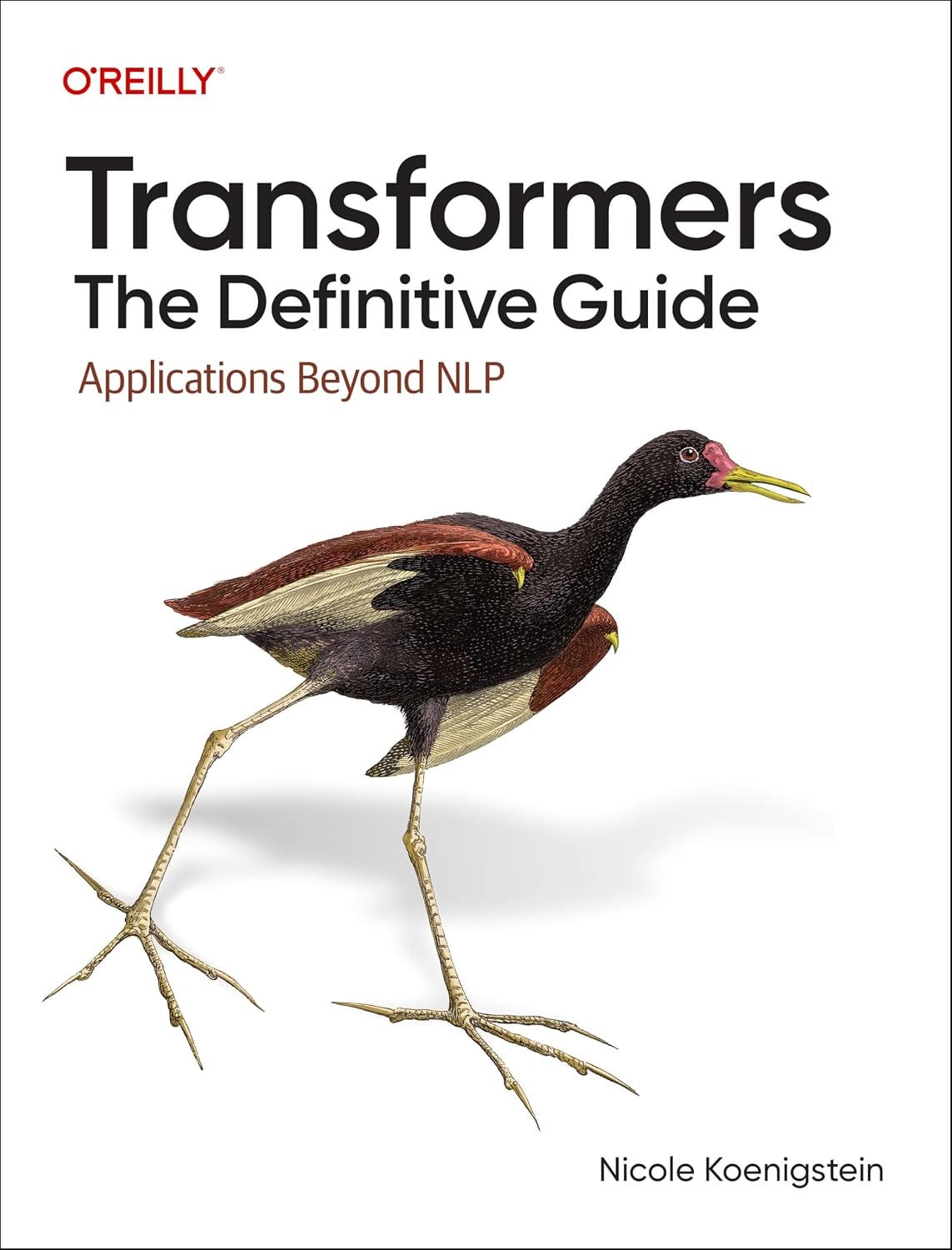
This book is ideal for intermediate-to-advanced machine learning engineers, data scientists, and researchers who want to understand how transformers work across multiple domains and how to optimize and deploy them in real applications.
The book is available on O’Reilly and for purchase on Amazon.
Have any questions? Please comment below!
See you next Saturday!
Thanks,
Rami
Thanks for reading Rami’s Data Newsletter! Subscribe for free to receive new posts and support my work.
Disclaimer: I use AI to help edit the content in this newsletter. If you spot a mistake, please leave a comment — I’d appreciate the heads-up.