
Mastering NLP From Foundations to Agents - Second Edition, the Qlib Project | Issue 80
A weekly curated update on data science and engineering topics and resources.

This week’s agenda:
Open Source of the Week - the Qlib project
New learning resources - Deep learning and GenAI courses, a prompt engineering crash course, and OpenClaw optimization
Book of the week - Mastering NLP From Foundations to Agents - Second Edition by Lior Gazit and Meysam Ghaffari.
📌 I share daily updates on TikTok, Telegram, and WhatsApp.

Are you interested in learning how to set up automation using GitHub Actions? If so, please check out my course on LinkedIn Learning:
Open Source of the Week
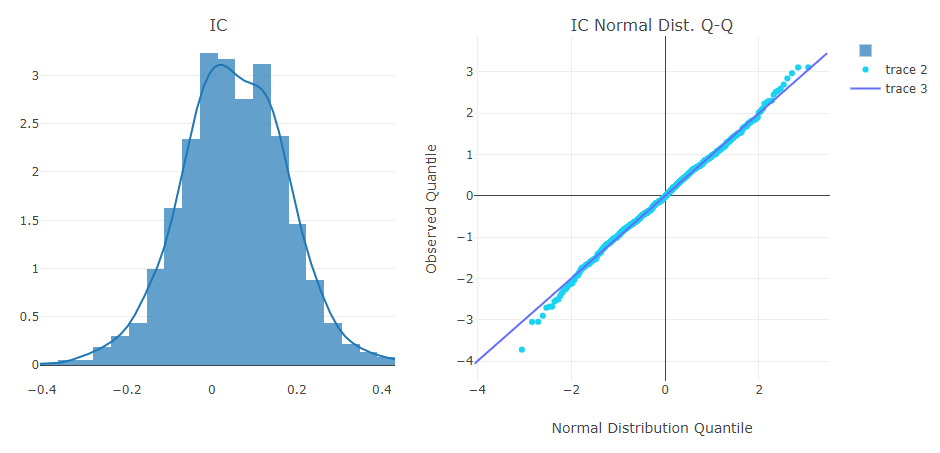
This week’s focus is on the Qlib project - an open source platform from Microsoft designed to support end-to-end quantitative investment research using AI and machine learning. It provides a full pipeline—from data ingestion and feature engineering to model training, backtesting, and portfolio optimization—allowing researchers and practitioners to develop, evaluate, and deploy trading strategies in a unified environment. By combining scalable data infrastructure with support for multiple ML paradigms (including supervised learning and reinforcement learning), Qlib addresses the complexity of financial markets and enables reproducible, data-driven experimentation in quantitative finance.
Project repo: https://github.com/microsoft/qlib
Key Features
Covers the full quant workflow, including data processing, modeling, backtesting, and execution
Supports multiple learning paradigms such as supervised learning, reinforcement learning, and market dynamics modeling
Provides a modular architecture with loosely coupled components that can be used independently or end-to-end
Includes a rich model zoo with implementations of common ML and deep learning models (e.g., LightGBM, LSTM, Transformers)
Enables automated research workflows (e.g.,
qrun) for training, evaluation, and reportingOffers a high-performance data infrastructure optimized for large-scale financial time series
Supports advanced tasks across the investment lifecycle, including alpha generation, risk modeling, portfolio optimization, and order execution
Extensible with tools like RD-Agent for automated factor mining and model optimization
More details are available in the project documentation.
License: MIT
New Learning Resources
Here are some new learning resources that I came across this week.
Deep Learning Course
The following course by edureka provides an introduction to Deep Learning. This 10-hour course covers topics such as:
Introduction
Math for machine learning
Deep learning with Python
Neural network
Convolutional neural network (CNN)
Recurrent neural network (RNN)
LSTM
Transformers
Generative AI Course
The following course by Intellipaat provides an in-depth introduction to Generative AI. This 11-hour course covers the following topics:
Introduction to Gen-AI
RNN
Gradient algorithm
Encoder and decoder algorithms
RNN and LSTM
Tokenization and padding
Hyperparameter tuning
Seq2Seq model
Prompt Engineering Crash Course
This new tutorial by Tech with Tim introduces prompt engineering. This includes the top techniques and methods, and advanced strategies to get the most out of loops.
Optimize OpenClaw
The following tutorial by Tech with Tim focuses on optimization methods to reduce token usage. This includes caching and context-pruning methods, as well as audit token usage.
Book of the Week
This week’s focus is on a new NLP book - Mastering NLP From Foundations to Agents - Second Edition by Lior Gazit and Meysam Ghaffari. This book offers a comprehensive, end-to-end journey through natural language processing — from core mathematical and machine learning foundations to modern deep learning techniques and large language models (LLMs). It combines theory with hands-on Python examples, enabling readers to build, evaluate, and deploy NLP systems while understanding how today’s LLM-powered applications work under the hood.
Topics covered in the book
Mathematical foundations for NLP — linear algebra, probability, statistics, and optimization as the backbone of ML/NLP models
Machine learning for text data — feature engineering, model training, evaluation, and handling real-world data challenges
Text preprocessing pipelines — tokenization, normalization, NER, POS tagging, and preparing text for modeling
Classical NLP tasks — text classification and traditional ML approaches for language understanding
Deep learning for NLP — neural networks, transformers, and modern architectures like BERT and GPT
Large Language Models (LLMs) — theory, training (including RLHF), capabilities, limitations, and real-world usage
Building LLM applications — prompt engineering, retrieval-augmented generation (RAG), and frameworks like LangChain
Advanced applications and trends — multi-agent systems, system design, and the future impact of NLP and AI
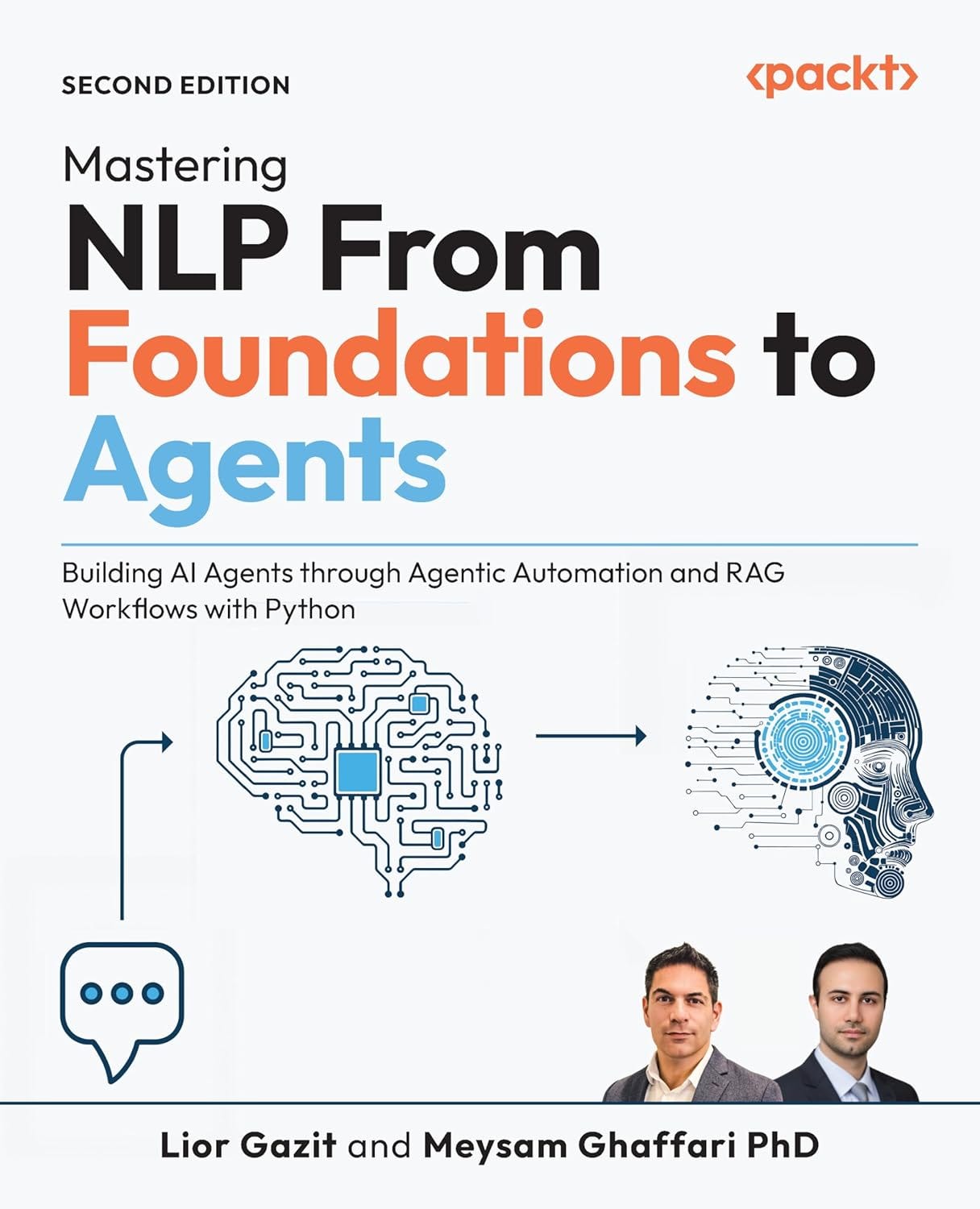
This book is ideal for data scientists, machine learning engineers, and developers with basic Python and ML knowledge who want to deepen their understanding of NLP — from foundational concepts to building modern LLM-powered applications in practice.
The book is available online on the publisher’s website, and a hard copy can be purchased on Amazon.
Have any questions? Please comment below!
See you next Saturday!
Thanks,
Rami