
Introduction to SQL AI Agents: The Four Components Behind Natural Language SQL
Part 1 of the Foundations of SQL AI Agents series

Most organizations store their most valuable information inside relational databases. Yet many of the people who need answers from that data don’t write SQL. Business stakeholders want to understand trends, support teams need operational insights, and product managers want to explore customer behavior, but translating those questions into database queries often requires specialized technical knowledge. As a result, access to data frequently becomes a bottleneck, with analysts and data teams serving as intermediaries between questions and answers.
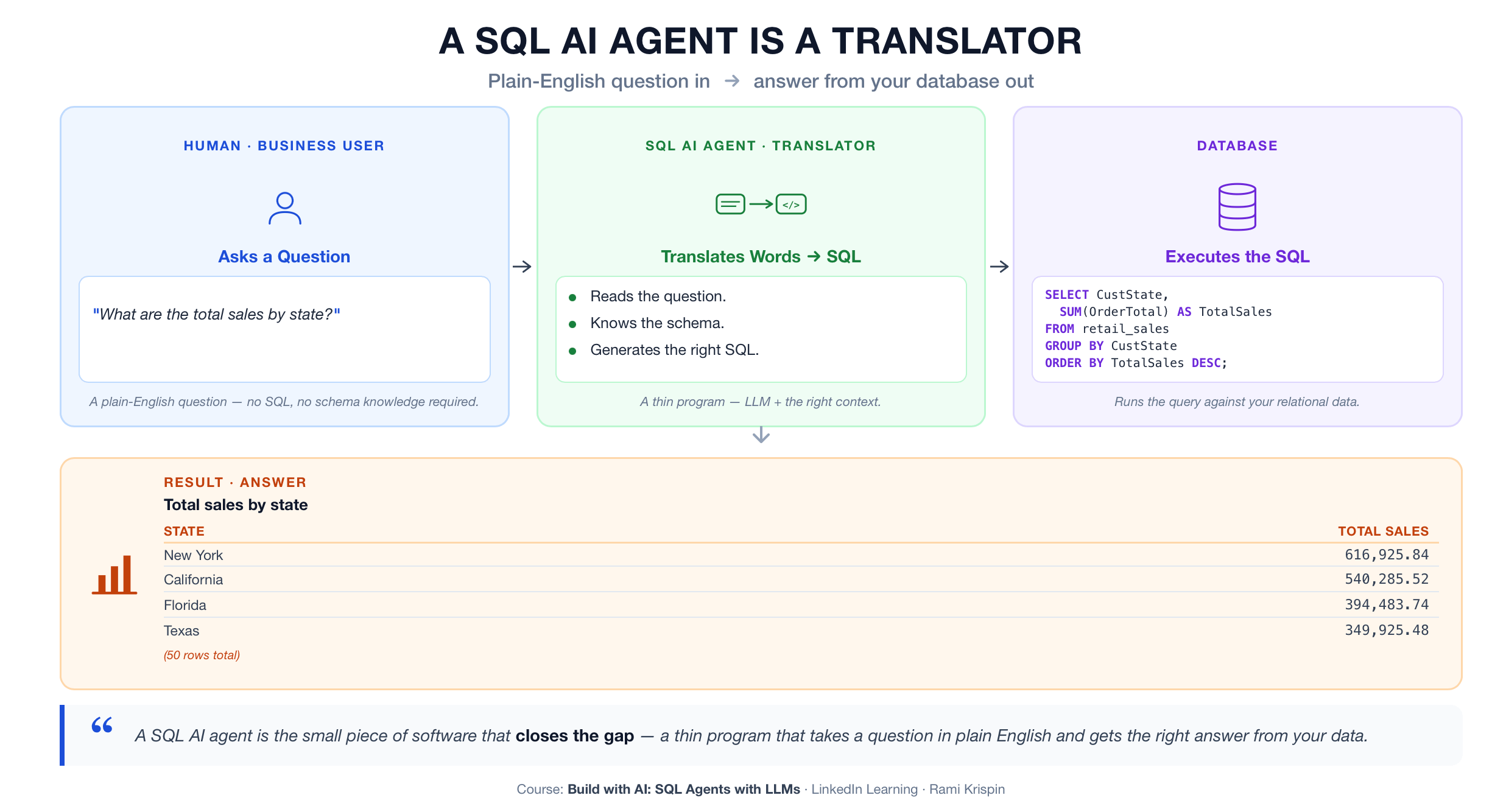
SQL AI agents emerged to bridge that gap.
A SQL AI agent is a lightweight application that allows people to interact with databases using natural language. Instead of writing SQL manually, users can ask questions such as:
How many retail orders did we receive last quarter?
The agent translates that request into SQL, executes the query against the database, and returns the result.
Large language models (LLMs) have made this workflow increasingly practical. Given the right instructions and enough context, modern models are remarkably effective at generating SQL. However, the real challenge isn’t whether an LLM can write SQL. The challenge is whether it can generate the right SQL for your data.
That distinction is important. Writing a correct SQL query requires more than understanding SQL syntax. It requires knowledge of the database schema, awareness of the SQL dialect being used, familiarity with business terminology, and an understanding of how metrics are defined within a particular organization. Without that context, even the most capable models tend to guess.
This article is the first installment in the Foundations of SQL AI Agents series. Throughout this series, we’ll explore the architecture, components, and design decisions involved in building SQL AI agents that answer questions about real data. Many of these concepts are drawn from my LinkedIn Learning course, Build with AI: SQL Agents with Large Language Models, where we build a working SQL AI agent from the ground up.
What Is a SQL AI Agent?
At its core, a SQL AI agent is a translator between humans and databases. The term agent is just a fancy name for a set of functions that orchestrate the process of taking a user question, processing it, generating a SQL query, and returning data, or in short, a pipeline.
People naturally express questions in business language:
Which regions generated the most revenue last quarter?
Databases, on the other hand, require precise instructions written in SQL. A SQL AI agent sits between those two worlds, converting natural language into executable database queries and transforming query results back into meaningful answers.
This capability has made text-to-SQL one of the most practical applications of generative AI. Organizations are increasingly exploring SQL AI agents to power internal analytics assistants, enable natural-language reporting, embed conversational analytics into products, and accelerate analysts’ work by reducing repetitive query writing.
Despite the excitement surrounding AI agents, the underlying architecture of an SQL AI agent is remarkably simple. Regardless of the programming language, framework, or model provider involved, most implementations can be understood as four distinct components working together in sequence.
The Four-Component Architecture of a SQL AI Agent
A user’s question enters one side of the system, and an answer emerges from the other. Between those two endpoints are four components, each with a single responsibility.
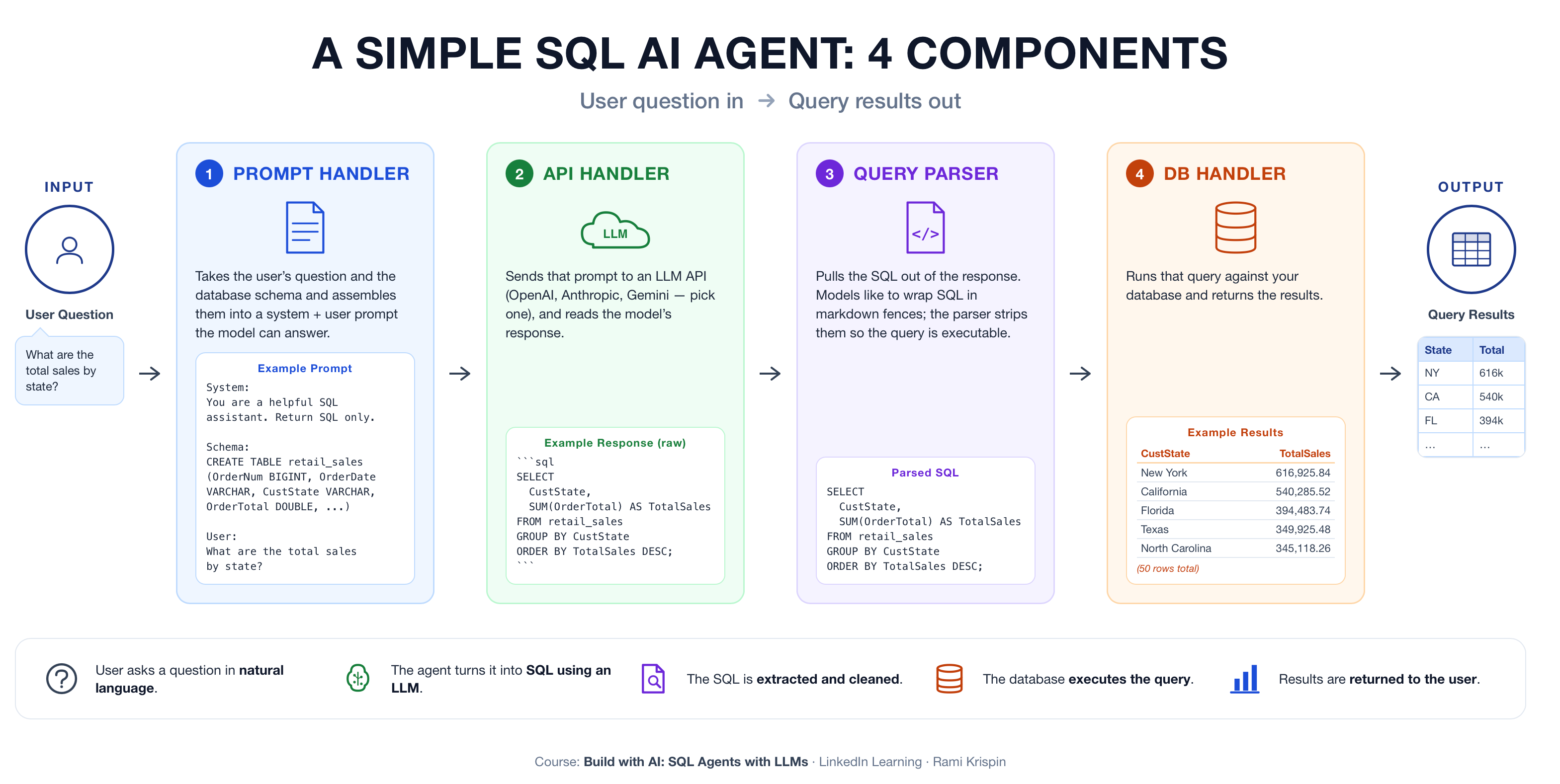
The simplicity of this architecture is one of its greatest strengths. By separating responsibilities into small, focused components, the system becomes easier to understand, maintain, and extend. When something goes wrong, it is also easier to identify where the problem originated.
Let’s examine each of these components in turn.
1. The Prompt Handler
The prompt handler assembles the information the language model needs to generate SQL.
A prompt for a SQL AI agent is much more than the user’s question. It typically includes the relevant database schema, instructions about the expected output format, and any business context available to the system. The prompt handler gathers these pieces and combines them into the final prompt presented to the model.
The simplest implementation might accept a table name and a question, retrieve the schema from the database, and inject both into a prompt template. Even in its most basic form, this step provides the context that transforms a general-purpose language model into an agent capable of reasoning about a specific database.
Without it, the model is left to guess which tables and columns might exist.
2. The API Handler
The API handler serves as the communication layer between the application and the language model.
Its responsibility is straightforward: send the prompt to the model provider and return the resulting response. While conceptually simple, this separation provides flexibility. Different providers expose similar interfaces, making it possible to switch models without rewriting the rest of the system.
As models evolve, the architecture remains stable.
3. The Query Parser
Language models don’t always return output in the exact format we expect.
Sometimes they produce clean SQL. Other times, they wrap the query inside markdown code fences or include explanatory text alongside the generated statement. While these differences are easy for humans to interpret, databases expect executable SQL and nothing more.
The query parser bridges that gap by extracting the SQL from the model’s response and preparing it for execution. It adds a small but important layer of reliability to the overall workflow.
4. The Database Handler
The database handler executes the generated SQL against the database and returns the results.
In many implementations, this is the simplest component in the system. Yet it is also the only component that interacts directly with real data. Everything that precedes it involves prompts, responses, and text processing. The database handler transforms those intermediate steps into answers that users can act upon.
Without execution, generated SQL remains only a suggestion.
Closing Thoughts
Individually, none of these components is particularly complex. A prompt handler assembles instructions, an API handler communicates with a model, a query parser prepares executable SQL, and a database handler retrieves results from the database. Together, however, they enable a fundamentally different way of interacting with data, one in which users ask questions in natural language and receive answers without having to write SQL themselves.
That simplicity can be deceptive.
The architecture provides the structure, but structure alone is not enough. The effectiveness of a SQL AI agent ultimately depends on the context it receives: the schema it understands, the business definitions it inherits, and the guidance it uses to bridge the gap between a user’s intent and a database’s reality.
In the next article, we’ll explore that missing ingredient—context—and why it is often the deciding factor between an impressive demonstration and a genuinely useful SQL AI agent.
Interested in learning more about SQL AI agents?
If you’d like to dive deeper into SQL AI agents, I’ve put together two LinkedIn Learning courses that cover the topic from beginner to advanced levels.
Build with AI: SQL Agents with Large Language Models – an introductory course that walks through the fundamentals of SQL AI agents and shows how to build one from scratch.
Build with AI: SQL AI Agents in Production – a more advanced course focused on the challenges of deploying SQL AI agents in real-world environments, including the considerations that come with taking them to production.
Whether you’re just getting started or thinking about production use cases, I hope you’ll find them helpful.