
Applied Time Series Analysis for the Social Sciences, the Freestiler Project | Issue 79
A weekly curated update on data science and engineering topics and resources.

This week’s agenda:
Open Source of the Week - The freestiler project
New learning resources - Stanford Artificial Intelligence’s new course, Gemini Embedding 2, training an AI model with agents, LLMs fine-tuning, CI/CD with Jenkins
Book of the week - Applied Time Series Analysis for the Social Sciences by Regina M. Baker
The newsletter is also available on LinkedIn and Medium.

Are you interested in learning how to set up automation using GitHub Actions? If so, please check out my course on LinkedIn Learning:
Open Source of the Week
This week’s focus is on the freestiler project - a new geospatial library for R and Python by Kyle Walker. This library enables the creation of PMTiles vector tilesets from an SF object, a file on disk, or a DuckDB SQL query. It uses Rust on the backend.
Project repo: https://github.com/walkerke/freestiler/
Key Features
Generates PMTiles vector tilesets from spatial data objects, files, or database queries.
Works with R and Python, enabling flexible integration into data science and geospatial workflows.
Accepts multiple input sources, including
sfobjects, GeoParquet files, Shapefiles, GeoPackages, and DuckDB queries.Uses a Rust-based tiling engine that runs in-process, avoiding the need for external tile-building tools.
Supports large-scale datasets through streaming pipelines that process data without loading everything into memory.
Allows creation of multi-layer tilesets and control over zoom levels, clustering, and geometry simplification.
Integrates with web mapping tools (e.g., MapLibre-based workflows) to visualize tiles in interactive maps.
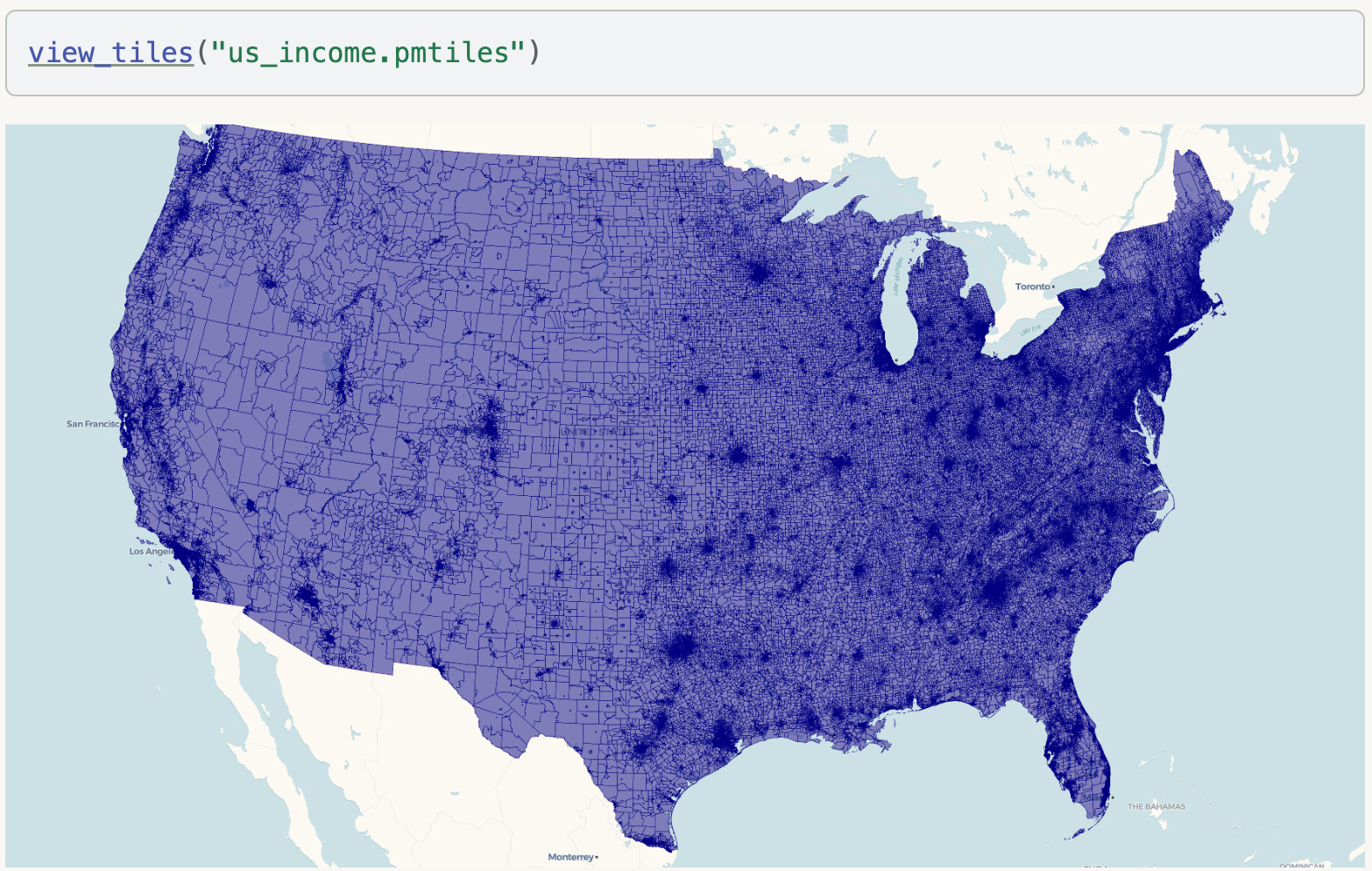
More details are available in the project documentation.
License: MIT
New Learning Resources
Here are some new learning resources that I came across this week.
Stanford just released the lecture videos for CS221: Artificial Intelligence – Principles and Techniques
This is one of Stanford’s core AI courses, covering the foundations of modern AI and the mathematical tools behind intelligent systems. Topics include:
Search algorithms
Machine learning
Markov Decision Processes
Game playing
Bayesian networks and probabilistic reasoning
Logic and constraint satisfaction
The course focuses on solving complex real-world problems with rigorous mathematical approaches and practical implementations.
Gemini Embedding 2
The following short video by Alejandro AO illustrates multimodel retrieval using Gemini Embedding 2 and ChromaDB.
Training Models with AI Agents
The following tutorial from Hugging Face provides a step-by-step introduction to automating the training of AI models from scratch using AI agents.
LLM Fine-Tune Course
The following course from Sunny Savita focuses on LLM fine-tuning using different techniques. This 12-hour course covers various fine-tuning approaches using the Hugging Face ecosystem and high-performance tools such as Unsloth and Axolotl. This includes:
Supervised fine-tuning
LoRA and QLoRA
RLHF and DPO
Multimodel
CI/CD in Production with Jenkins
The following course by Varun Joshi is an in-depth introduction to CI/CD for DevOps with Jenkins. This 17-hour course includes the following topics:
Modern SDLC
CI/CD concepts and branching strategies
Jenkins settings
Running jobs with Jenkins
Dockerized Flask App
Transition to multibranch pipelines
Book of the Week
This week’s focus is on a new time-series book, Applied Time Series Analysis for the Social Sciences, by Regina M. Baker. This book provides a practical introduction to time series analysis, focusing on modeling and forecasting sequential data across disciplines such as economics, finance, climatology, and public health. It balances theoretical foundations with step-by-step applications, helping readers understand core time series concepts without overwhelming mathematical detail while demonstrating how models are implemented in practice.
Topics covered in the book
Foundations of time series analysis — key concepts, lag operators, and intuition behind dynamic models.
Stationarity and unit root testing — identifying trends, testing for stationarity, and transforming data using differencing.
Autocorrelation and time-series processes — understanding autocorrelation, moving average (MA), autoregressive (AR), and ARMA processes.
ARIMA modeling and forecasting — building, estimating, and forecasting with ARIMA models and seasonal extensions.
Intervention and transfer function models — analyzing the impact of events or external variables on time series.
Regression with time-series data — handling autocorrelation, generalized least squares, and distributed lag models.
Cointegration and error-correction models — modeling relationships between non-stationary variables.
Vector autoregression (VAR) — introducing multivariate time-series models for studying dynamic interactions.
LSE modeling approach — general-to-specific modeling and model evaluation strategies.
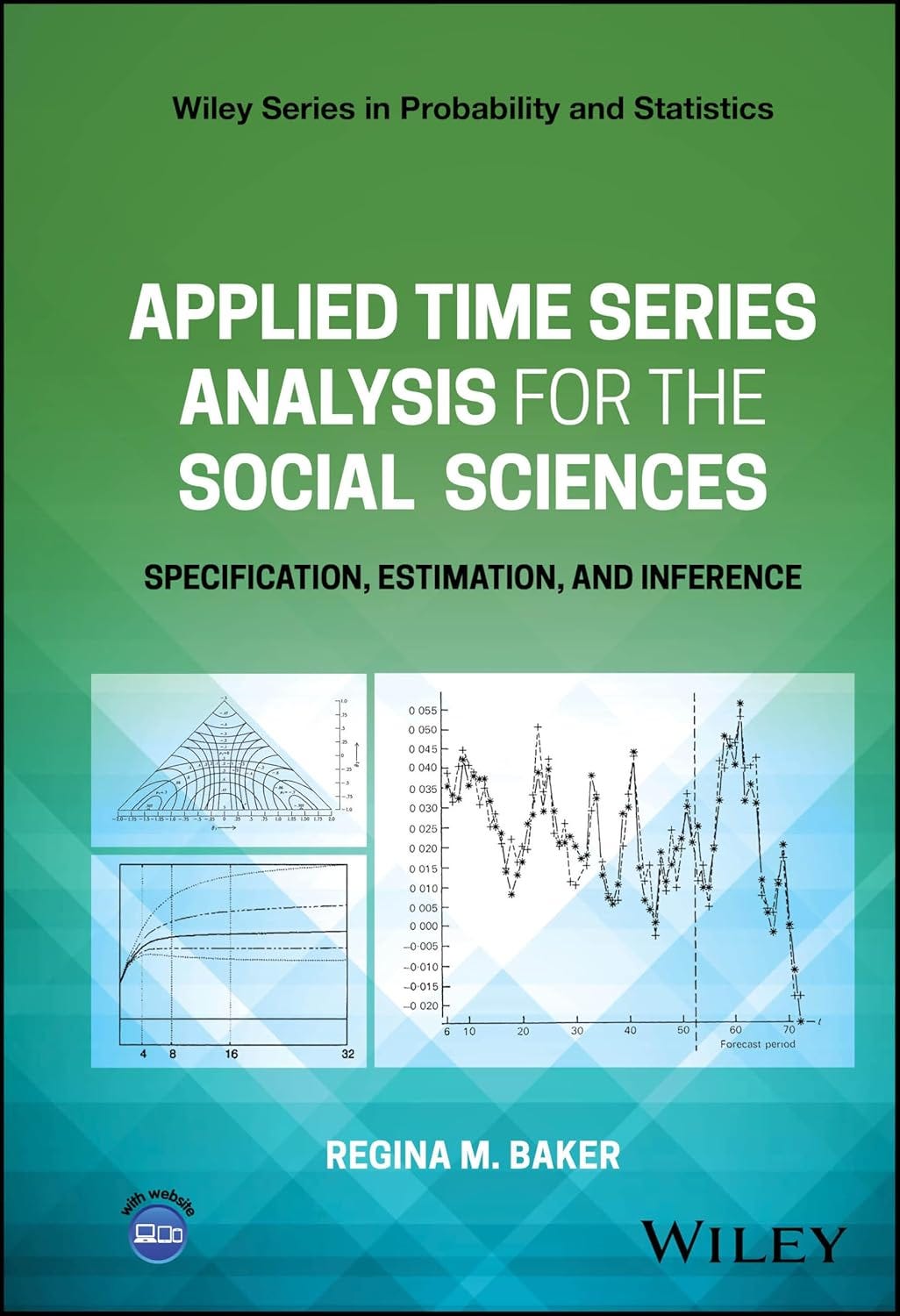
This book is ideal for graduate students, researchers, and analysts who work with time-dependent data and want a practical guide to modern econometric time series modeling and forecasting methods across multiple application domains.
The book is available online on the publisher’s website, and a hard copy can be purchased on Amazon.
Have any questions? Please comment below!
See you next Saturday!
Thanks,
Rami